
What is ACD Calibration Gas?
Advanced Calibration Designs (ACD) was founded in 1988 with the mission to develop and manufacture the most dependable, accurate, reliable, and affordable gas calibration standards in the world.
Simply put, Advanced Calibration Designs are gas calibration devices that are superior to the previous approaches to calibrating gas detection monitors by generating gas on demand as required.
Advanced Calibration Designs exceed the limitations of all previous forms of calibrating gas monitors. They do this through Integrated and Expandable products that provide the backbone of the new era in calibration gas standards.
- Most economical method to calibrate sensors and instruments
- Portable and easy to ship
- No inherent shelf life
- NIST traceable
- EASY to use
- No gas storage or wastage
- Expandable, one unit, many gases
- Gas supply or simple bump testing
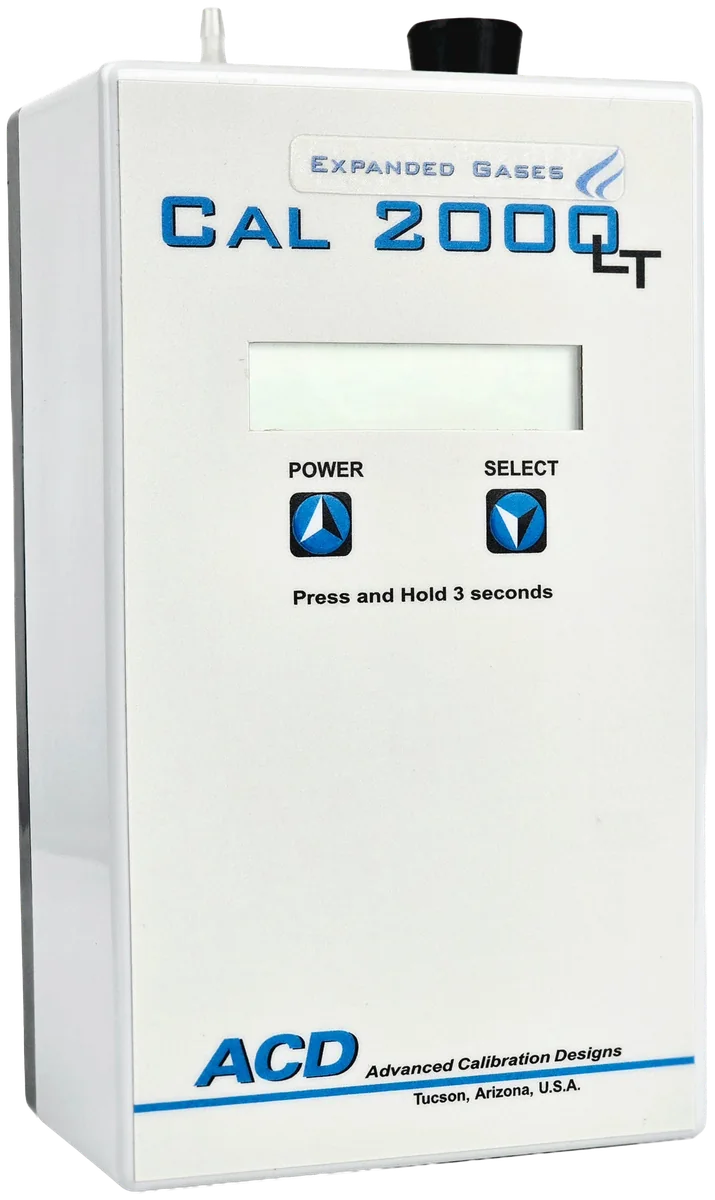
Or Simply, Choose Your Calibrator


ACD Gas Calibration Gas Generators
Why do I need to calibrate my gas monitor?
Generally, gas monitors are placed in potentially hazardous areas that are damaging to monitor systems, causing degradation over time. Zero and span levels will vary as the gas sensors age and are exposed to harsh environments. All sensors have finite lifespans and must be replaced periodically, and to test that the sensors are responding correctly, each sensor needs to be exposed to the gas that it is detecting to confirm it is working and is reading accurately. This ensures safety in the workplace, preventing the frustration of false alarm conditions. Many sensors will read zero concentration, appear to be working, and read zero when exposed to gas when they are no longer working. Bump testing and calibration will confirm if the sensor in question is indeed working correctly.
How often do I need to calibrate my gas monitor?
There are no hard and fast rules governing the frequency that your sensor needs to be calibrated. General guidelines are suggested by your manufacturer for the system you have. In general, you should calibrate your sensors on a fixed schedule and then see how it responds. If you start by calibrating them every week, and you notice they are always right on the span and zero values, you may move the frequency back to every other week and go from there. It is really hard to give general rules because every environment is different, but certainly calibrate your sensors after any event, such as a leak in that area where the sensor has come in contact with the gas. We suggest that a new system start with a periodic calibration as suggested by the manufacturer, and then adjust it as you monitor the performance of your system from calibration to calibration.
Why would I buy an ACD instrument rather than a cylinder of cal gas?
Our gas instruments are more accurate, versatile, price effective and environmentally friendly than cylinders.
How do the instruments work?
There is a liquid containing generating source inserted into the instrument. Current is passed through the source and calibration gas is generated on demand and blended with air to create calibration gas or it simply permeates out and is blended with air to create calibration gas.
How long do the calibration gas sources last?
We have a range of gas sources that run from 2 to 100 hours of use, roughly the equivalent of 2 to 100 cal gas cylinders at a fraction of the cost.
Can I use one instrument to generate more than one type of cal gas?
Most instruments can be used with several gas sources. For instance, you can have one CAL 2000 instrument and five different generating sources for it.
Specification, Not Order Taking
Tell us the detector, the target gas, the alarm level and the environment. We come back with the part that actually works, and the reason.